📌 Introduction: Why Multi-Agent Systems Fail at Scale
Enterprise adoption of artificial intelligence has moved beyond single-purpose chatbots. Organizations now deploy multi-agent systems—collections of autonomous AI agents that collaborate to solve complex business problems. From supply chain optimization to customer service orchestration, these systems promise unprecedented agility and efficiency. However, a common misconception persists: that scaling a multi-agent system is simply a matter of adding more agents. In reality, without deliberate design patterns, multi-agent systems become chaotic, costly, and impossible to govern.
The challenges are well documented. Agents duplicate work, communication overhead explodes, and debugging becomes a nightmare. Worse, without proper controls, costs can spiral as agents engage in endless loops or redundant queries. For enterprises, these failures are not just technical annoyances—they translate to lost revenue, compliance risks, and eroded trust in AI solutions.
This article addresses these challenges head-on. Drawing on proven patterns from distributed systems and real-world enterprise deployments, we present a set of design patterns specifically tailored for multi-agent systems at scale. You will learn how to structure agent interactions, manage state, enforce governance, and optimize performance. Whether you are building your first multi-agent prototype or scaling an existing deployment, these patterns will help you avoid common pitfalls and build robust, production-grade systems.
📌 The Foundation: Architectural Patterns for Multi-Agent Systems
Before diving into specific coordination patterns, it's essential to establish a solid architectural foundation. Multi-agent systems are inherently distributed, so principles from microservices and event-driven architecture apply. The choice of architectural pattern sets the stage for scalability, maintainability, and fault tolerance.
Orchestrator-Worker Pattern
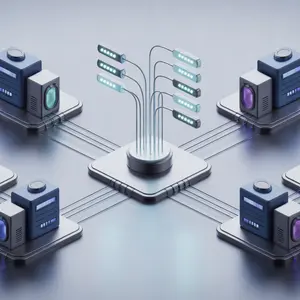
In this pattern, a central orchestrator agent decomposes tasks and assigns them to specialized worker agents. The orchestrator maintains the global state and coordinates the workflow, while workers focus on narrow, well-defined tasks. This pattern is ideal for processes with clear dependencies and a need for centralized control. For example, a financial report generation system might have an orchestrator that retrieves data from multiple sources via worker agents, then aggregates and formats the final report. The key benefit is simplified governance: the orchestrator enforces policies, logs actions, and handles errors. However, the orchestrator can become a bottleneck if not designed for high availability and load balancing.
Event-Driven Choreography
In contrast to orchestration, choreography relies on events to trigger agent actions. Agents communicate through an event bus, reacting to events without a central coordinator. This pattern excels in dynamic environments where workflows are not predetermined. For instance, in a customer support system, an incoming complaint event might trigger sentiment analysis, knowledge base lookup, and escalation agents—all operating independently. Choreography reduces coupling and improves scalability, but it complicates debugging and governance. Enterprises must implement robust event logging and tracing to maintain observability.
Hierarchical Agent Teams
For complex domains, hierarchical structures mirror human organizations. A top-level agent sets goals, mid-level agents manage sub-goals, and leaf agents execute tasks. This pattern supports recursive decomposition and is natural for planning problems. However, it introduces latency and requires careful design to prevent excessive depth. A common approach is to limit hierarchy depth and use caching to avoid redundant planning.
Choosing the right architectural pattern depends on your use case. Enterprises should evaluate factors such as workflow predictability, need for centralized control, and scalability requirements. Often, a hybrid approach—combining orchestration for critical paths and choreography for peripheral tasks—yields the best results.
📌 Coordination and Communication Patterns
Once the architecture is set, the next challenge is enabling effective coordination and communication among agents. Poorly designed interactions lead to message storms, deadlocks, and inconsistent state. The following patterns address these issues.
Blackboard Pattern
Inspired by expert systems, the blackboard pattern uses a shared data store (the blackboard) that agents read from and write to. Agents specialize in different aspects of the problem and contribute partial solutions. A controller agent monitors the blackboard and decides when a solution is complete. This pattern is excellent for problems that require incremental problem-solving, such as anomaly detection or resource allocation. However, it requires careful concurrency control to prevent race conditions. Enterprises should implement optimistic locking or versioning to manage concurrent writes.
Contract Net Protocol
The contract net protocol is a decentralized coordination mechanism where a manager agent announces a task, and worker agents bid based on their capabilities and current load. The manager selects the best bid and awards the contract. This pattern promotes load balancing and fault tolerance, as tasks are dynamically assigned. It is particularly useful in environments with heterogeneous agents and varying workloads. To prevent bidding wars and ensure fairness, enterprises should define clear bidding criteria and timeouts.
Publish-Subscribe with Semantic Routing
For event-driven systems, publish-subscribe (pub-sub) is a natural fit. Agents publish events to topics, and interested agents subscribe. However, in large systems, topic proliferation can become unmanageable. Semantic routing enhances pub-sub by routing events based on content rather than static topics. For example, an event containing a customer complaint might be routed to agents specializing in the product mentioned. This requires a semantic router—often an AI model—that classifies events. While powerful, semantic routing adds latency and cost, so it should be used judiciously.
Effective coordination also demands standardized communication protocols. Enterprises should adopt a common message format (e.g., JSON with schema) and define interaction patterns such as request-response, fire-and-forget, and streaming. Without standardization, integration becomes brittle and expensive.
📌 State Management and Persistence Patterns
Multi-agent systems generate and consume vast amounts of state. Managing this state consistently across agents is critical for reliability and user experience. The following patterns help enterprises handle state at scale.
Event Sourcing with CQRS
Event sourcing stores all changes as a sequence of events, rather than just the current state. Combined with Command Query Responsibility Segregation (CQRS), it separates read and write models, enabling agents to query optimized views while writes are append-only. This pattern provides a complete audit trail—essential for compliance—and allows agents to replay events to recover from failures. For example, a multi-agent trading system can use event sourcing to reconstruct market state after a crash. The trade-off is increased complexity and storage requirements, so enterprises should apply it to critical domains only.
Agent State Snapshots
For long-running agents, periodic snapshots of internal state enable quick recovery and scaling. Snapshots can be stored in a durable store like a database or object storage. When an agent restarts, it loads the latest snapshot and replays subsequent events. This pattern is simpler than full event sourcing and works well for agents with moderate state size. Enterprises should define snapshot frequency based on recovery time objectives (RTO) and recovery point objectives (RPO).
Shared Memory with Consistency Guarantees
Some multi-agent systems require shared memory for collaboration, such as a shared workspace for document editing. Distributed shared memory introduces consistency challenges. Enterprises can choose from strong consistency (e.g., via distributed locks) or eventual consistency (e.g., via conflict-free replicated data types, CRDTs). The choice depends on the application's tolerance for stale reads. For real-time collaboration, CRDTs offer low latency and automatic conflict resolution, but they are not suitable for all data types.
State management is often overlooked until problems arise. By incorporating these patterns early, enterprises can avoid costly refactoring and ensure their multi-agent systems are resilient and auditable.
📌 Governance, Security, and Observability Patterns
Enterprises operate under strict regulatory and security requirements. Multi-agent systems introduce new risks: agents may access sensitive data, make unauthorized decisions, or be compromised. Governance patterns are essential to maintain control and trust.
Policy Enforcement Point (PEP) and Policy Decision Point (PDP)
Borrowed from security architectures, this pattern separates policy enforcement from decision-making. A PEP intercepts every agent action (e.g., API call, data access) and queries a PDP for authorization. The PDP evaluates policies based on context (agent identity, data sensitivity, time) and returns a decision. This centralized approach ensures consistent policy application and simplifies audits. Enterprises can implement PDP as a service that agents call before critical actions. To reduce latency, decisions can be cached with short time-to-live.
Agent Identity and Least Privilege
Each agent should have a unique identity and be granted only the permissions necessary for its role. This follows the principle of least privilege. Enterprises can use mutual TLS or OAuth tokens to authenticate agents. Additionally, agents should be isolated in sandboxes or containers to limit the blast radius of a compromise. Regular rotation of credentials and monitoring for anomalous behavior further strengthen security.
Distributed Tracing and Logging
Observability is non-negotiable. Distributed tracing, using standards like OpenTelemetry, allows enterprises to follow a request as it flows through multiple agents. Each agent should emit spans with context, enabling end-to-end visibility. Logs should be structured and correlated with trace IDs. For AI agents, it's also crucial to log the reasoning or decision process—often via chain-of-thought logs—to enable debugging and compliance audits. However, logging sensitive data must be avoided or masked.
Governance patterns should be complemented by a centralized control plane that manages agent lifecycles, versions, and configurations. This control plane acts as the single source of truth for agent deployment and policy updates.
📌 Performance and Scalability Patterns
As multi-agent systems grow, performance bottlenecks emerge. Agents may compete for resources, communication overhead increases, and latency-sensitive tasks suffer. The following patterns help maintain performance at scale.
Agent Pooling and Load Balancing
Instead of spawning a new agent for each request, maintain a pool of pre-initialized agents that can handle tasks concurrently. A load balancer distributes incoming tasks based on agent load and capability. This pattern reduces startup latency and improves resource utilization. Enterprises should implement health checks and auto-scaling to adjust pool size based on demand. For stateful agents, sticky sessions or externalized state are necessary.
Caching and Memoization
Many agent tasks are repetitive. Caching results of expensive operations—such as LLM calls or database queries—can dramatically reduce cost and latency. Memoization at the agent level stores results keyed by input. Enterprises should implement a distributed cache (e.g., Redis) with appropriate eviction policies. Care must be taken to invalidate caches when underlying data changes.
Asynchronous and Batch Processing
Not all tasks require immediate response. For batch-oriented workloads, agents can process tasks asynchronously, perhaps using a message queue. This decouples producers from consumers and allows better resource utilization. For example, a multi-agent system for nightly report generation can queue tasks and process them in parallel. Enterprises should define service level objectives (SLOs) for latency and design accordingly.
Performance patterns should be validated through load testing. Enterprises should simulate peak loads and measure key metrics: throughput, latency, error rate, and cost per transaction. Continuous monitoring and profiling help identify regressions early.
📌 Common Mistakes in Multi-Agent System Design
Even with patterns in hand, teams often stumble. Here are pitfalls specific to enterprise-scale multi-agent systems:
- Over-engineering the architecture: Adopting complex patterns like event sourcing or hierarchical teams without a clear need. Start simple and evolve.
- Neglecting governance from day one: Trying to bolt on security and auditing later leads to costly refactoring and compliance gaps.
- Ignoring communication overhead: Allowing agents to chat freely without structured protocols results in message storms and unpredictable costs.
- Underestimating state management: Failing to plan for state persistence and consistency causes data loss and inconsistent user experiences.
- Skipping observability: Without tracing and logging, debugging multi-agent interactions becomes guesswork, increasing mean time to resolution (MTTR).
Each of these mistakes can be avoided by following the patterns outlined in this article and by adopting an iterative, test-driven approach to multi-agent development.
📌 Conclusion: Building Reliable Multi-Agent Systems with Niravin
Design patterns are the bedrock of enterprise-scale multi-agent systems. By applying architectural, coordination, state management, governance, and performance patterns, organizations can build AI solutions that are robust, scalable, and trustworthy. The journey begins with a clear understanding of your use case and a commitment to incremental improvement.
At Niravin, we specialize in helping enterprises design and deploy multi-agent systems that deliver real business value. Our expertise in artificial intelligence and business AI ensures that your systems are not only technically sound but also aligned with your strategic goals. Whether you are just starting or looking to optimize an existing deployment, our team can guide you through the complexities.
Next step: Conduct a design review of your current or planned multi-agent system using the patterns and checklist provided. Identify gaps and prioritize improvements based on risk and impact. Then, reach out to Niravin for a personalized assessment and roadmap.
❓ Frequently Asked Questions
What is the difference between orchestration and choreography in multi-agent systems?
Orchestration uses a central controller to direct agent activities, providing clear control and simplified governance. Choreography relies on agents reacting to events without a central coordinator, offering greater flexibility and scalability but complicating debugging. The choice depends on workflow predictability and the need for centralized policy enforcement.
How can I prevent runaway costs in a multi-agent system?
Implement budgeting and rate limiting per agent, use caching to avoid redundant LLM calls, and monitor usage with alerts. Design patterns like agent pooling and asynchronous processing also help optimize resource consumption. Regularly review agent logs to identify inefficiencies.
What governance patterns are essential for compliance?
Policy Enforcement Points (PEP) and Policy Decision Points (PDP) ensure consistent policy application. Agent identity with least privilege limits access. Comprehensive logging and distributed tracing provide audit trails. These patterns together enable compliance with regulations like GDPR and HIPAA.
How do I test a multi-agent system before production?
Use simulation environments to mimic agent interactions and edge cases. Implement chaos engineering to test resilience. Load test to validate performance under stress. And conduct security audits including penetration testing. Continuous monitoring in production with canary releases further reduces risk.
✅ Implementation Checklist for Enterprise Multi-Agent Systems
- Define clear goals and success metrics for the multi-agent system.
- Choose an architectural pattern (orchestrator-worker, choreography, hierarchical) aligned with use case.
- Establish standardized communication protocols and message schemas.
- Implement state management (event sourcing, snapshots, or shared memory) with consistency guarantees.
- Enforce security with agent identity, least privilege, and PEP/PDP.
- Instrument distributed tracing and structured logging for observability.
- Design for performance with agent pooling, caching, and asynchronous processing.
- Conduct regular design reviews and load testing.
- Establish a centralized control plane for agent lifecycle management.
- Plan for incremental rollout with canary releases and rollback strategies.